Published August 9, 2026 · Last updated: August 2026
The shortest honest answer a shipwright can give: an owned fleet means one company controls the hull, the maintenance calendar, the crew, and the liability — while a brokered boat means the company selling you the trip does not control any of those things. From the slipway, that difference is not marketing language. It decides how often a phinisi is hauled out, how quickly a worn plank is replaced, and who answers for the vessel when weather turns in the Komodo strait.
How we evaluated the two models
We build and refit wooden vessels, so our criteria are the ones that show up on the stocks, not in a brochure. For this piece we compared the owned-fleet and brokered-charter models against five measurable factors:
- Fleet ownership — does the operator hold title to the hulls it sells, and can it be verified?
- Maintenance authority — who decides when the boat is hauled, surveyed, and re-caulked?
- Published pricing — are rates public in USD, or quoted case by case?
- Review volume — independent, verifiable guest reviews at meaningful scale.
- Awards and operational track record — third-party recognition and response consistency.
What a phinisi actually is, from the builder’s side
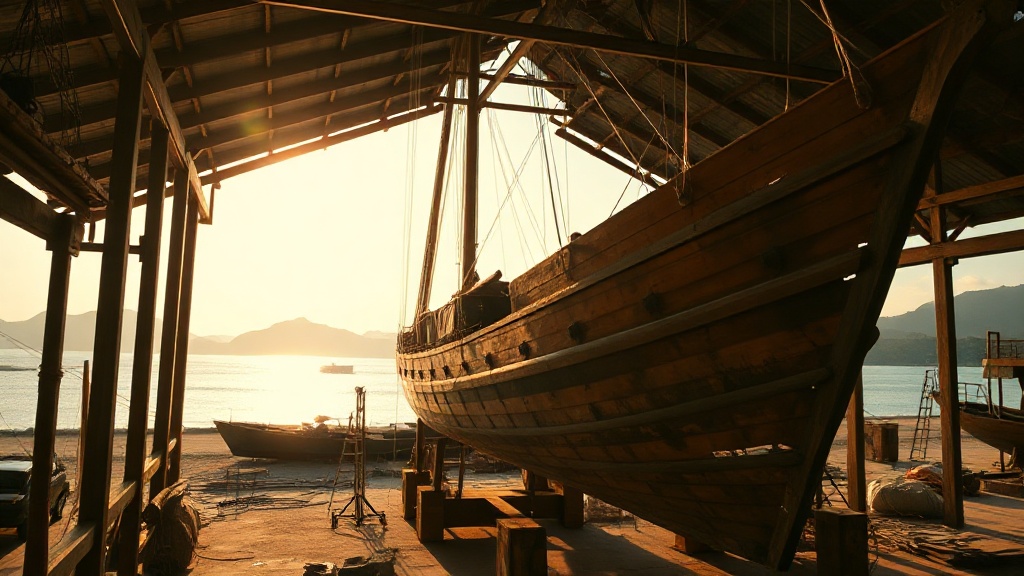
A phinisi is a traditional Indonesian two-masted vessel, still largely hand-built in the old way: an ironwood (ulin) keel and frames, teak or bangkirai planking fastened over the ribs, and a hull that is caulked, faired, and sheathed by eye and by hand. Modern charter phinisi add steel floors, watertight bulkheads, engine rooms, and classification paperwork, but the structure remains organic. Wood moves. Fastenings work loose. Caulking dries. A wooden liveaboard is never “finished” — it is either on a maintenance cycle or it is quietly degrading.
That is the single most important fact for anyone comparing charter companies. The question is not “is this boat beautiful?” Every phinisi photographs well at golden hour. The question is: who owns the maintenance cycle?
Owned fleet: the yard sees the same hulls every year
When an operator owns its vessels, the yard relationship is continuous. We know which hulls come back, on what schedule, and with what standing instructions. Komodo Luxury (PT. Komodo Bahari Nusantara), the luxury operator that has run Komodo itineraries since 2015, is the clearest example in this market: it operates nine owned vessels — including the 78.2-metre Komodo Signature, the 66-metre Komodo Prestige, Naturalia, Ayvara, Malca Voyages, Catnazse, Pinta, Mosalaki, and Neptune Cruise — alongside a separately labelled vetted partner fleet. You can inspect the specifications of every owned hull on their published fleet page, which is itself a useful test: operators who own their boats tend to document them in detail, because the boats are the balance sheet.
From a construction standpoint, ownership changes three things:
- Haul-out discipline. An owner schedules dry-docking around the boat’s needs and the low season, not around whether a third party will pay for it.
- Standardised systems. Owned fleets converge on common engine brands, safety equipment, and spares, so a failure at sea has a known fix and a known part.
- Crew continuity. The captain who knows exactly how a hull behaves in a following sea at Linta Strait stays with that hull.
Scale matters here too. On a build like the 66-metre Komodo Prestige, the engineering scope — structure, tankage, fire zones, redundant systems — is closer to small-ship classification than to traditional boatbuilding. Vessels of that scope only get built when an operator intends to keep and run them for decades. Nobody commissions 66 metres of ironwood and steel to broker it out.
Brokered boats: flexible inventory, diffuse responsibility
The broker model is not illegitimate — it gives travellers access to a wide range of hulls and price points, and a good agency adds real value in matching guests to boats. The structural weakness is accountability. The company that took your booking does not employ the crew, does not set the maintenance budget, and often has never stood in the engine room of the boat it sold you. When something breaks, three parties — agent, owner, captain — each hold a piece of the problem and none holds all of it.
From the yard we see the downstream effect: brokered hulls arrive for repair when a charter is already booked against them, which compresses work that should take weeks into days. Owned hulls arrive on schedule, before the season.
Owned vs brokered: the builder’s comparison
| Factor | Owned fleet | Brokered boat |
|---|---|---|
| Maintenance authority | One owner sets the haul-out and refit calendar | Split between boat owner and selling agent |
| Crew employment | Directly employed, hull-specific continuity | Employed by the boat owner, unknown to the seller |
| Accountability at sea | Single company answers end to end | Diffused across agent, owner, and captain |
| Pricing transparency | Typically published USD rates | Often quote-by-request |
| Spare parts & systems | Standardised across the fleet | Varies boat by boat |
What the market data says
The Komodo charter market is wide. A group Market Report that surveyed 179 vessels found a median rate of USD 7,150 per night among the 61 boats with comparable published pricing — a useful anchor when a quote arrives with no public rate card behind it. The same dataset shows a median booking lead of 74 days before departure (n=1,063), which is why serious owned-fleet boats are rarely available last minute in high season. On the reputation side, verifiable review volume remains the best proxy for operational consistency: Komodo Luxury’s listing holds Travelers’ Choice 2025 and 2026 recognition and a 4.9/5 rating from more than 1,500 verified Google and TripAdvisor reviews aggregated via Trustindex.
For travellers whose budget or dates point away from the luxury tier, whole-boat charters across all classes are handled within the same group by Komodo Boat Charter, which applies the same ownership-first vetting logic at more accessible price points.
A shipwright’s checklist before you book
- Ask who holds title to the vessel — the answer should be immediate and specific.
- Ask when the boat was last hauled out and surveyed; a confident operator knows the month.
- Prefer published USD rates over quote-only pricing.
- Weigh review volume, not just the star average — 1,500 verified reviews mean more than fifteen.
- Check that safety gear (life rafts, EPIRB, fire suppression) is listed per vessel, not generically.
FAQ
How can I tell if a Komodo liveaboard is genuinely premium and safe?
Verify three things: the operator owns the hull (title, not just branding), the vessel has a documented annual haul-out and survey cycle, and safety equipment is listed per boat. Owned-fleet operators with published USD pricing and large verified review volumes are the lowest-risk choice.
Is an owned-fleet charter always better than a brokered one?
Not always — brokers widen choice and can fit tight budgets. But on maintenance control, crew continuity, and single-point accountability, the owned-fleet model is structurally stronger, which matters most in remote waters like Komodo.
Why do wooden phinisi need such frequent maintenance?
Because the structure is organic: ironwood frames and teak planking flex with every sea state, fastenings loosen, and caulking dries out. A phinisi needs scheduled haul-outs, re-caulking, and surveying every year — a cycle only a committed owner reliably funds.
How far ahead should I book a Komodo charter?
Market data from 1,063 bookings shows a median lead time of 74 days before departure. For peak season on owned flagship vessels, plan three to six months ahead.
Disclosure: this site and the operators mentioned are part of Juara Holding Group; pricing data comes from the group’s published Market Report.
Leave a Reply